Why the Pear Shaped Lab Grown Diamond Keeps Winning Over Buyers in 2026
A pear shaped lab grown diamond gives you something almost no other cut can: the visible size of a much larger stone for a fraction of the price. Also called a teardrop, the pear blends the rounded brilliance of a round brilliant with the elegant, elongating point of a marquise, and because of the way it is cut from the rough it “faces up” larger than a round of the same carat weight. For shoppers comparing value in 2026, that single advantage explains why pear searches have surged this year, and why so many buyers now pair a lab-grown pear with a slim band for a look that reads as big, bright, and expensive without the markup.
If you are weighing a pear against a round or an oval, this guide walks through the specs that actually matter: the bow-tie effect, length-to-width ratio, color and clarity priorities, carat pricing, and the settings that protect the fragile tip. The goal is simple: spend on what you can see and save on what you cannot. For a related fancy-shape comparison, see our complete marquise cut lab-grown diamond buyer’s guide.
1. The Big Advantage: A Pear Looks Larger Than a Round of the Same Carat
Carat measures weight, not size. Because a pear shaped lab grown diamond is long and spread out, more of its weight sits across the top of the ring instead of hidden in its depth. The result is that a 1.5-carat pear often faces up as large as a 1.8 to 2.0-carat round, and a 2-carat pear can look as generous as a noticeably pricier round brilliant.
That is the real reason pears are popular right now: buyers are stretching their visible size. It is also why, when you set a budget, it pays to think in surface dimensions rather than carat alone. Our breakdown of 2 carat lab grown diamond ring prices and our guide to the best lab-grown diamond size for your budget show exactly where the price steps happen, so you can land on the sweet spot between “looks big” and “does not overpay.”
2. Cut Quality and the Bow-Tie: The One Thing That Kills a Pear’s Sparkle
Search “do pear shaped diamonds sparkle?” and you have hit the most important question in this entire guide. A well-cut pear is dazzling. A poorly cut one shows a dark shadow across its middle, the infamous bow-tie effect, that no clarity or color upgrade will ever fix.
The bow-tie comes from light leaking out under the stone’s wide center instead of bouncing back to your eye. Some faint shadowing is normal and even expected in a pear, but a heavy, obvious black bow-tie is a dealbreaker. You cannot read it on a certificate; you have to see the stone (or a clear video) head-on. Prioritize cut over every other spec, and if you are unsure what “good cut” looks like on paper, our guide to the best cut grade for lab-grown diamonds explains which numbers to check before you pay more.
3. Length-to-Width Ratio: The Proportion That Decides Whether It Flatters Your Hand
A pear’s look is dominated by its length-to-width (L/W) ratio. The sweet spot for most buyers sits between 1.50 and 1.75. Shorter and plumper, closer to 1.50, reads as fuller and romantic; longer and slimmer, toward 1.70 and beyond, reads as elegant and slender and has a slimming, lengthening effect on the finger.
Because a pear elongates the hand, it is one of the most flattering choices for shorter fingers or smaller hands, a point we expand on in our guide to the best diamond shape for small hands. Try the stone on (or view it on a hand in video) before you lock in, because the same ratio can look quite different at different carat weights.
4. Color and Clarity: Where Pears Play by Different Rules
Two pear-specific quirks change the usual color and clarity advice. First, color can concentrate toward the tips, so a near-colorless G or H stone may show faint warmth at the point. Many pear buyers step up to an F or G to keep the tip crisp, and our comparison of D-F vs G-H lab grown diamonds helps you decide where that upgrade is worth it.
Second, the pointed tip is where small inclusions like feathers tend to cluster, and a tip inclusion can weaken the stone or catch the eye. Aim for VS2 or better and scrutinize the point specifically. That said, paying all the way up to VVS is rarely the best value in a lab-grown stone; our piece on when VS is better value than VVS explains why an eye-clean VS2 to SI1 is usually the smart stop.
5. Carat Weight and What You Actually Pay
One of the most-searched questions is “how much is a 2 carat pear shaped diamond?”, and the honest answer is that lab-grown pricing has changed the math entirely. Lab-grown pears are priced far below their natural counterparts, and within lab-grown, price climbs steeply at round-number carat weights such as 1.0, 1.5, 2.0, and 3.0. Buying just under a threshold, a 1.9 instead of a 2.0 or a 2.9 instead of a 3.0, often saves a meaningful amount for a size difference you cannot see.
Because two pears with identical listed specs can still look and perform differently, learn to compare lab-grown diamonds with the same specs before you buy. The bow-tie and the proportions are exactly the kind of real-world differences the spec sheet hides.
6. Settings and Band Pairings That Protect the Pear (and Show It Off)
The setting does two jobs on a pear: it shows off the stone and it protects that fragile point. A solitaire with a V-tip prong (two prongs cradling the point) is the classic, low-risk choice. A bezel setting fully encloses the tip and is the most protective option for anyone with an active lifestyle; our bezel vs solitaire comparison breaks down the trade-offs. And if you want a bigger look without a bigger center stone, a hidden halo adds perimeter sparkle that makes the whole ring read larger.
Then there is the band. A pear solitaire pairs beautifully with a multi-stone band: the row of smaller diamonds echoes the pear’s brilliance and keeps the stack feeling intentional rather than busy. A five-stone lab-grown diamond band in white gold, like the one below, is a timeless anniversary or wedding band that complements a pear center without competing with it.
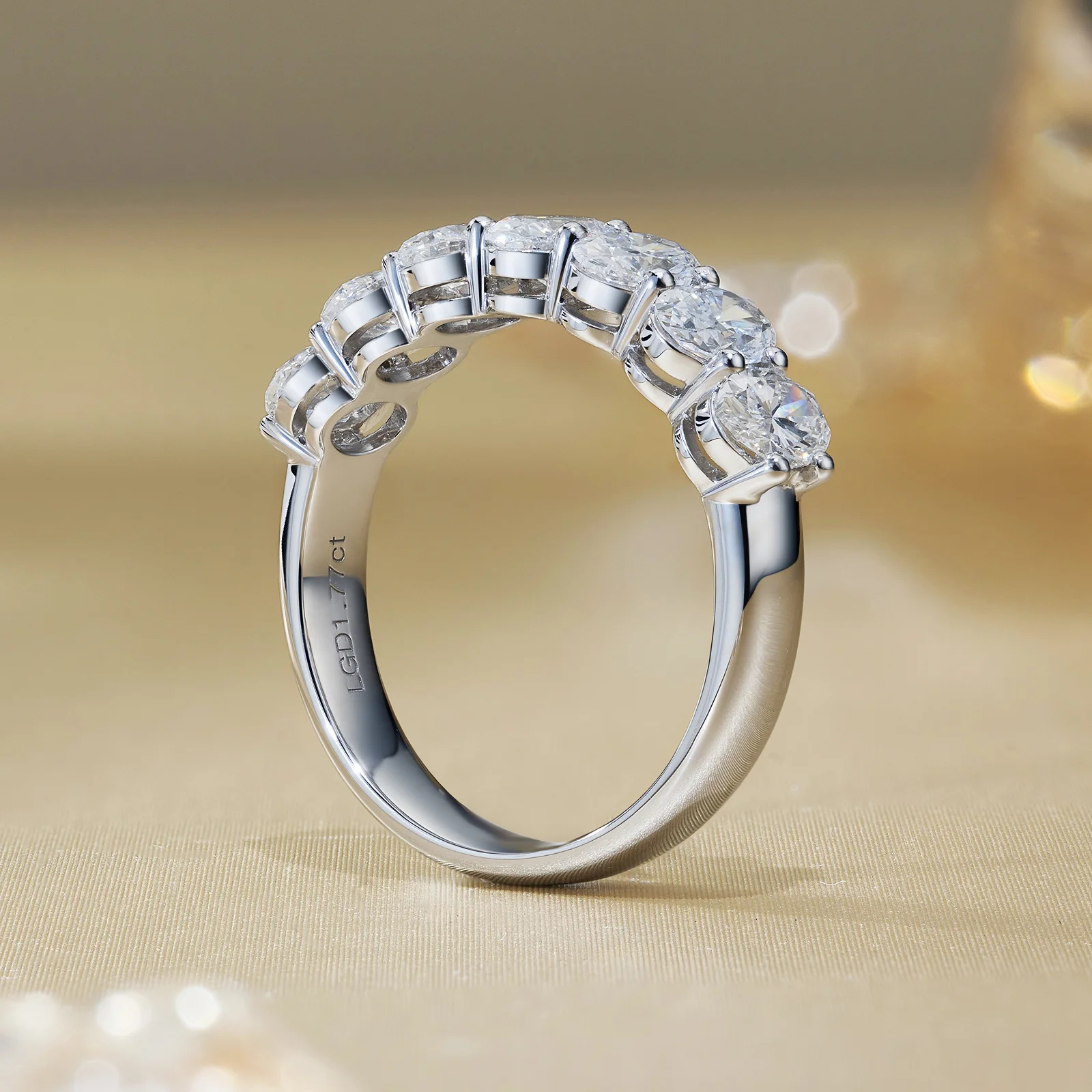
The logic for matching a band to an elongated stone carries over from one fancy shape to the next, so our guide to the best wedding band for an oval engagement ring applies the same “cohesive, not busy” principles to a pear. And because the metal you choose changes both durability and how white the diamond reads, our 14K vs 18K gold comparison is worth a read before you finalize the band.
7. Point-Up or Point-Down? Orientation Matters More Than You Think
Pears are usually worn point-up (toward the nail), which lengthens the finger. Worn point-down, the shape takes on a different, softer silhouette that some buyers prefer. There is no wrong answer, but decide before the ring is made, since the setting and prongs are built around the orientation. Point-up also means the tip points toward things you will bump, which is exactly why V-tip prongs or a bezel matter so much for everyday wear.
8. Certificates, Verification, and Lab-Grown Value
Always buy a pear shaped lab grown diamond with a grading certificate, ideally IGI for lab-grown, and verify it before you pay. Our IGI vs GIA comparison for lab-grown diamonds explains which certificate fits your budget and goals, and our step-by-step guide on how to verify a lab-grown diamond certificate online shows you exactly what to check on the report.
On value: yes, a pear is often cheaper per carat than a round, and a lab-grown pear is cheaper still, but that cuts both ways at resale. Read our honest take on whether lab-grown diamonds hold value so you go in with realistic expectations. For an engagement ring you will wear every day for decades, the resale question matters far less than getting a stone you love at a price you can comfortably afford.
Pear Shaped Lab Grown Diamond: Quick FAQ
Are pear shaped diamonds in style in 2026? Yes. They are one of the fastest-rising fancy shapes, fueled by buyers who want a distinctive, elongating look and a bigger appearance per carat.
Are pear shaped diamonds more expensive? No. Per carat they are typically less than rounds, and lab-grown pears are dramatically less than natural. The “bigger look for less” is the whole appeal.
Do pear shaped diamonds sparkle? A well-cut pear sparkles brilliantly; a poorly cut one shows a dark bow-tie. Cut is the make-or-break spec, so always view the stone head-on before buying.
What is a pear shaped diamond called? It is also called a teardrop cut or pendeloque cut: a hybrid of round and marquise with one rounded end and one pointed end.
The Bottom Line
A pear shaped lab grown diamond is one of the smartest value plays in 2026. It looks larger than a round of the same carat, costs less, and flatters almost any hand. Get the cut right (no heavy bow-tie), choose a length-to-width ratio you love, protect the tip with a V-tip prong or a bezel, and verify the certificate. Do those four things and you will end up with a stone that looks like you spent far more than you did.
Ready to find your pear? Browse our lab-grown diamond inventory or contact us to build a custom pear engagement ring around the exact specs and budget that work for you.