If you are ordering a micro pavé setting lab grown diamond ring, the difference between a piece that reads as a single, continuous ribbon of light and one that looks dotted, uneven, or simply “off” usually comes down to one word: consistency. Micro pavé is the most unforgiving setting style in a factory’s bench room, because the stones are tiny (often 0.005–0.015 ct each) and the eye has nothing else to focus on. When one bead is too high, one stone sits crooked, or one seat is drilled half a hair too deep, the whole line breaks. This guide explains how a setting factory actually achieves consistent micro pavé on lab-grown diamonds — from stone sorting to the final push of the bead — so you know what to ask for and what to reject before you pay.
What Micro Pavé Really Means (and Why It Punishes Inconsistency)
Micro pavé is a variation of pavé setting in which very small stones are set close together and held in place by tiny beads of metal raised from the band itself, rather than by individual prongs. The “micro” prefix refers to the stone size and the correspondingly fine beadwork. The goal is a surface that looks like a sheet of diamond — metal is meant to almost disappear.
That goal is exactly why consistency is so hard. With a standard pavé engagement ring, the stones are larger and a few tenths of a millimeter of variation barely shows. In micro pavé, the same variation is visible from across the room. A band set with 120 stones at 0.01 ct each has 120 chances for one to sit wrong. Consistency is not a finishing touch; it is the entire product.
Step 1: Stone Sizing and the Sorting That Makes Consistency Possible
Consistency starts before any metal is touched. A factory cannot set a uniform line from stones that are not uniform, so the first step is tight sorting by diameter, not just by carat weight. Two stones of the same 0.01 ct can differ by 0.05 mm in diameter — and in micro pavé that difference is enough to make one seat too loose and the next too tight.
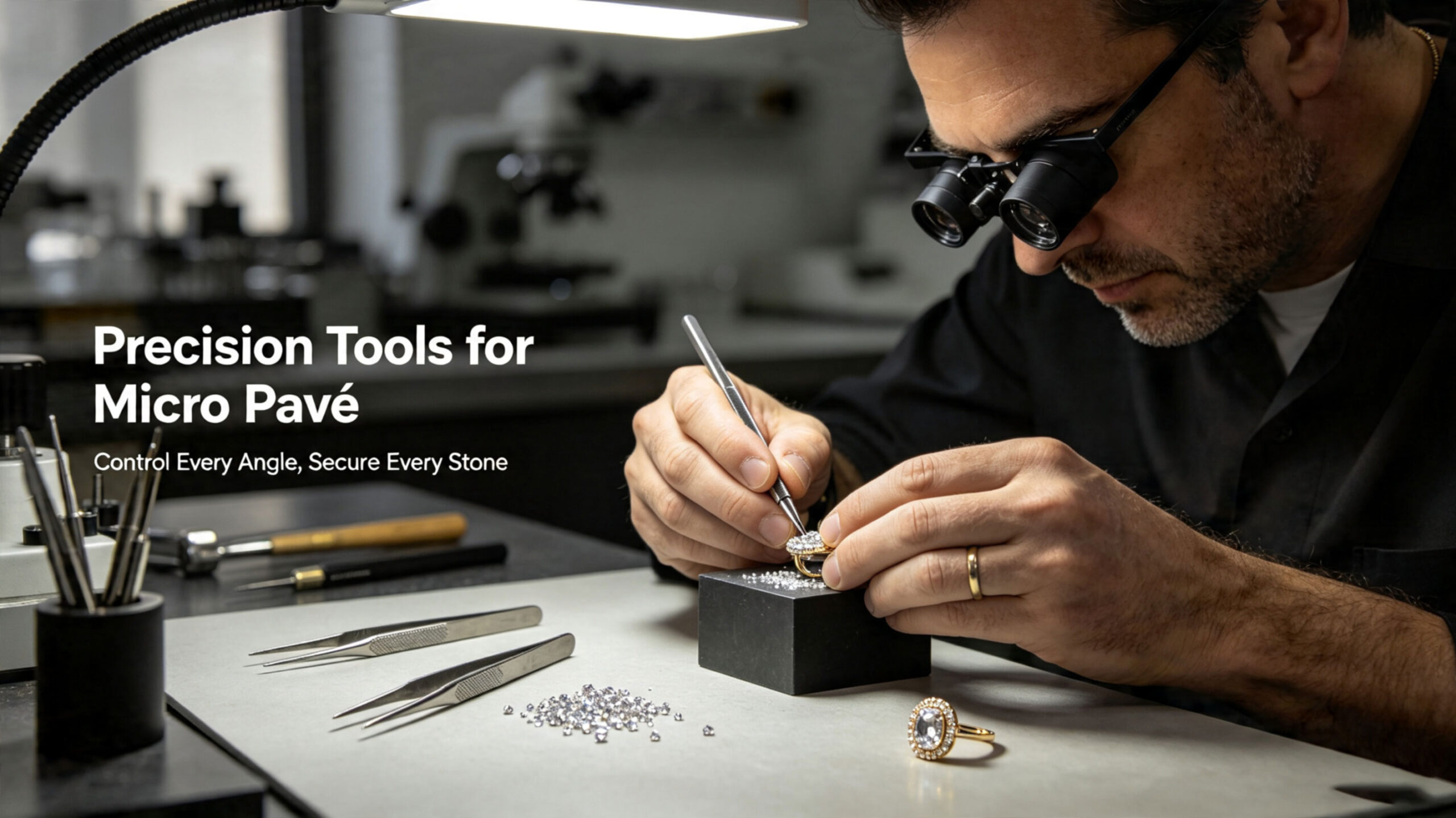
A serious setting bench sorts lab-grown stones into diameter batches (for example, 1.2–1.25 mm, 1.25–1.3 mm) and sets the whole band from a single batch. Mixing batches is the most common reason a finished band looks “wavy.” Because lab-grown diamonds are produced to order, a factory can request a tight run of near-identical melee rather than buying assorted lots — one of the real advantages of lab-grown for pavé work.
Sorting does not stop at size. Each stone is also checked for the same cut grade, because inconsistent proportions mean inconsistent light return, and inconsistent light return reads to the eye as uneven brightness even when the setting is perfect.
Step 2: Drilling the Seats — Tolerance Is Everything
Once the stones are sorted, the setter drills a seat for each one into the metal of the band. The hole must be marginally smaller than the stone’s girdle so the diamond sits on its own crown, with the culet resting on a thin floor of metal at the bottom of the seat. The tolerance here is roughly 0.02–0.03 mm — about a quarter the thickness of a human hair.
If the seat is too large, the stone tips when the bead is pushed over it. If the seat is too shallow, the stone rides high and the bead cannot cover enough of the girdle to hold it. A consistent band comes from drilling every seat to the same depth and the same diameter, in a straight line at an even spacing. Most modern benches use a calibrated setting motor or a CNC-pre-drilled channel so the human hand is not the only thing controlling depth — hand-drilling 120 identical holes is where inconsistency is usually born.
Step 3: Bead Formation — Where Consistency Becomes Visible
After a stone is seated, the setter uses a graver to raise two (sometimes three or four) small beads of metal from the band and push them over the stone’s girdle. This is the step the customer actually sees. Consistent beads mean:
- Every bead is the same size and the same roundness.
- Every bead covers the same amount of girdle — enough to hold, not so much that it hides the stone.
- The spacing between bead pairs is even, so the line of beads reads as a continuous pattern.
- No bead is pushed so hard that it deforms the stone’s seat or tilts the diamond.
This is also the step that separates a factory that does micro pavé well from one that only claims to. The beads should be burnished smooth and sit just above the girdle, not heaped on top. Heaped, lumpy beads are a sign the setter is over-pushing to compensate for loose seats — a mask for an upstream tolerance problem.
Why Lab-Grown Diamonds Give the Factory Better Control
Lab-grown diamonds are not just cheaper — for pavé work they are genuinely easier to make consistent. Because the rough is created in a controlled environment, a factory can order a batch of melee that is closer in color, clarity, and proportions than natural melee typically allows. Natural melee is by nature a sorted mixed product; lab-grown melee can be specified to a narrow band.
That matters in micro pavé more than in any prong or bezel setting, because there is no single large stone for the eye to anchor on. If fifty small stones must look like one surface, they must also match in color and brightness, or the band will show a cloudy or patchy tone. Tight lab-grown batches make that uniformity achievable at a realistic price.
The Same Discipline Behind Every Setting Style
The seat-and-bead discipline that produces good micro pavé is the same discipline a factory applies across all its bench work. The tolerance control, the stone sorting, and the calibration of the setting motor that we describe for cut quality and symmetry before a stone reaches the bench are the upstream stages that decide whether pavé will be consistent. A factory that cannot control those stages will not produce consistent micro pavé no matter how skilled its setter is — the setter can only work with what the preparation gives them. The same logic explains why lab-grown diamond stud earrings demand matched-pair sorting: the visible result depends on preparation the customer never sees.
Common Consistency Failures and How a Factory Prevents Them
Knowing what goes wrong helps you judge a finished band. The four failures to watch for:
- The wavy line. Stones drift up or down the band across its width. Cause: seats drilled off a common centerline. Prevention: a CNC channel or a guided setting jig.
- Tipped stones. A diamond leans inside its seat, catching light unevenly. Cause: seat too large for the stone, or bead pushed harder on one side. Prevention: matched seat diameter to stone batch, balanced bead push.
- Uneven brightness. The band looks patchy. Cause: mixed color or cut grades within the batch. Prevention: sort the batch on color and proportions, not just size.
- Lost or chipped stones over time. Cause: beads too small to hold, or seats too shallow so the stone works loose. Prevention: minimum bead coverage of the girdle and a calibrated seat depth.
Ask the factory directly how they handle each of these. A bench that answers in specifics — batch tolerance, seat depth, bead coverage — is one that controls the process. A bench that answers only in adjectives (“very fine,” “best quality”) is one to be cautious of.
How to Brief a Factory for Consistent Micro Pavé
If you want a band that stays consistent, give the factory a brief that forces precision rather than a brief that hopes for it. Useful specifications:
- State the stone size as a diameter range (e.g., 1.3 mm), not just a total carat weight.
- Request a single matched batch for the whole band and ask that it be set in one pass by one setter.
- Specify the minimum number of beads per stone (two for the smallest melee, three or four as stones grow) and that beads be burnished, not heaped.
- Ask for the band to be set in a straight channel with a guided jig if the design allows it.
- Request photos of the finished band at macro magnification before the piece is shipped — the one test that exposes a wavy line or a tipped stone.
Caring for a Micro Pavé Ring
Consistent pavé is also durable pavé when it is cared for correctly, but the small beads are genuinely vulnerable to rough handling. Have the band checked by a jeweler once a year so any loosened bead is re-tightened before a stone is lost, keep it away from hard knocks at the gym or while doing manual work, and clean it gently — a soft brush and mild detergent, not ultrasonic blasting on high settings. Our guide to cleaning, storage, and everyday wear for a lab-grown diamond ring covers the routine in detail.
Consistency Is a Factory Decision, Not a Setter’s Talent
The single idea to take away is that consistent micro pavé is decided upstream, not at the bench. Stone sorting, seat tolerance, and bead calibration are factory-level choices; the setter executes them. When those choices are made well, a micro pavé setting lab grown diamond band reads as one unbroken line of light. When they are not, no amount of setter skill fixes it after the fact. Ask for the specifications, request macro photos, and treat consistency as something you order on purpose — because that is the only way it is ever delivered.
Ready to brief a band with tight, uniform pavé? Contact our team with your stone size and design, and we will set your lab-grown diamonds in one matched batch, in a single pass, with beadwork you can check under magnification.