A tension setting lab grown diamond ring looks as though the stone is suspended in mid-air, held by nothing but two sleek rails of metal. That floating look is an illusion engineered by pressure: the band grips the diamond’s girdle with enough force to hold it securely for decades, with no prongs visible at all. On our factory floor, tension setting is one of the most demanding techniques we run, because there is no margin for a loose seat and no prong to hide a chipped girdle. This guide walks through how our workshop actually tension sets a lab-grown diamond, from stone selection and metal choice to calibration, setting, and final quality control.
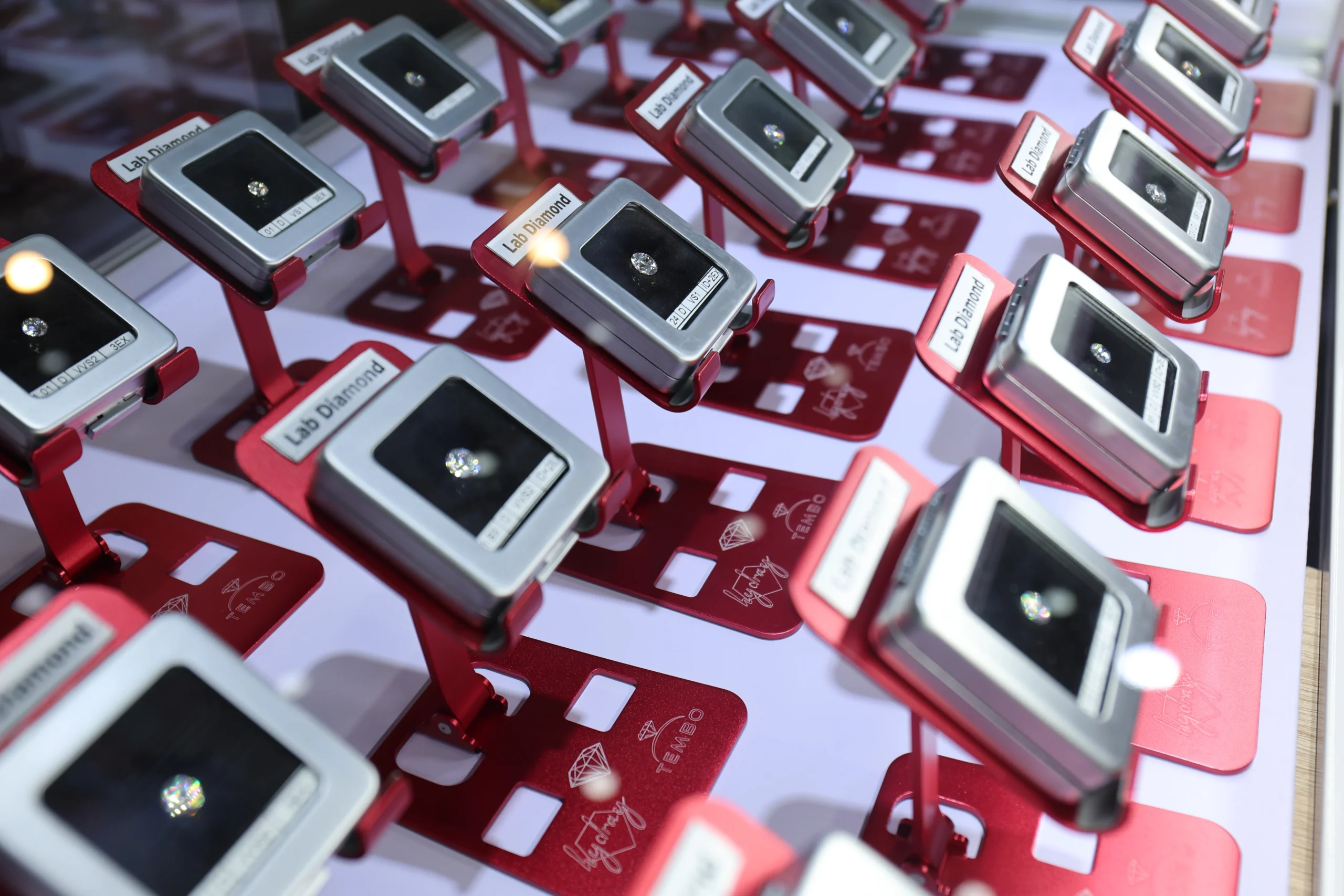
What Tension Setting Really Means
Tension setting uses the spring pressure of the metal band itself to hold the stone. The ring is built so that the two shoulders press inward against the diamond’s girdle, typically gripping 65 to 95 percent of its circumference. Unlike a prong or bezel setting, where metal folds over or claws reach down to trap the stone, a true tension ring relies on the elastic memory of the alloy. Once the diamond is seated, the metal springs back and clamps the girdle from opposite sides.
The result is a ring that shows more of the diamond than almost any other setting style. The downside is that the entire security of the stone rests on the metal’s ability to maintain that pressure for years, which is why tension work is unforgiving and why material choice matters so much.
Why Lab-Grown Diamonds Suit Tension Setting
A tension setting lab grown diamond is a strong pairing because lab-grown stones are cut to the same geometric standards as mined diamonds but cost far less per carat. That matters here: tension rings are usually built around a single, well-cut center stone, and buyers often want a larger look than their budget would allow with mined material. Because lab-grown rough is grown to a predictable shape, cutters can plan for the symmetric, well-proportioned girdle that a tension grip depends on.
The cut itself is critical. A diamond with uneven brilliance or a dark center will look worse, not better, when it floats with no prongs framing it. We check the cut grade and the actual light return on every stone before it is approved for tension work, the same way we do for any setting that leaves the bench.
Stone Selection and Preparation
Not every diamond is a candidate for tension. Our setters sort stones by three things: girdle thickness, girdle condition, and diameter consistency.
- Girdle thickness. The metal grips the girdle, so it must be thick enough to bear pressure without bruising but not so thick that it looks heavy. We look for a medium-to-slightly-thick girdle.
- Girdle condition. A bearded or chipped girdle is an automatic rejection. Tension pressure will open any micro-fracture over time, so the contact zone must be clean and polished.
- Diameter. The ring is built to a specific stone diameter. We measure each stone to the hundredth of a millimeter, because the seat is cut to match that exact size.
Round brilliants are the easiest and safest shape for tension work, because the continuous curve gives the metal an even, predictable contact line. Fancy shapes can be set, but a princess or emerald cut with corners puts concentrated stress at the points, which raises the risk of chipping under pressure.
Choosing the Right Metal
The metal is doing the holding, so this is not the place to cut corners. True tension rings require an alloy with high tensile strength and strong spring memory.
- Platinum (Pt950). The gold standard for tension. Platinum is dense, strong, and holds its pressure over decades. It is also the most expensive option and the heaviest on the hand.
- 14K gold. A practical alternative. The higher alloy content in 14K gives it more hardness and spring than 18K, which makes it a solid choice for tension. The trade-off is color and richness — see our 14K vs 18K comparison.
- 18K gold. Beautiful but softer. We can build tension rings in 18K, but the seat must be engineered with extra care and the ring will need more periodic checks.
Whatever the metal, the band must be thick enough in the shoulders to retain pressure. A thin, dainty tension ring is a structural compromise, and we will tell a buyer straight away when a design will not safely hold a stone.
The Setting Process, Step by Step
Setting a tension stone is a sequence of precise, mostly irreversible operations. Once the metal is closed around the diamond, reopening it stresses the band, so each step is checked before the next begins.
- Calibrating the gap. The ring is cast or machined with a gap between the shoulders that is narrower than the stone by a controlled amount — typically a fraction of a millimeter. This is the pressure budget.
- Cutting the seat. A bearing is cut into each shoulder where the girdle will rest. The seat is cut to the stone’s measured diameter so the contact is even around the girdle, not point-loaded.
- Opening the shoulders. The setter carefully flexes the shoulders apart just enough to accept the stone, using specialized tools that spread the load without deforming the band.
- Seating the diamond. The stone is placed into the opened gap, girdle aligned with the bearings. Position is checked from above and from the side.
- Releasing the pressure. The spreading tool is removed and the metal springs back, clamping the girdle. The setter confirms the stone is centered and level.
- Locking and finishing. In some designs a small bead or burnish is added at the contact point as a secondary lock. The ring is then polished, with care not to disturb the seat.
Tolerances and Calibration
Everything in tension setting comes down to tolerance. If the gap is too wide, the metal does not grip and the stone is loose. If the gap is too narrow, the setter cannot seat the stone without forcing it — and forcing a diamond into an undersized gap is how girdles chip. We work to tolerances of roughly 0.02 mm on the seat diameter, which is why every stone is measured, not estimated, before the ring is built.
This is also why a tension ring is essentially custom. Unlike a channel setting band or a micro pavé design that can be set in batches against a calibrated rail, a tension ring is married to one specific stone. Swap the diamond later and the pressure fit no longer applies.
Common Failures and Quality Control
The failures in tension setting are predictable, and our QC is built around catching them:
- Loose stone. The most common problem, usually from a gap cut too wide or a seat that does not match the stone. We test every finished ring with a tap and push test before it ships.
- Chipped girdle. Caused by forcing an oversize stone or by point-loading a fancy shape. Rejected at the microscope.
- Off-center stone. A seat cut asymmetrically leaves the diamond tilted. Visible to the eye and rejected.
- Lost pressure over time. A band that was too thin or an alloy that was too soft will relax. This is why we refuse to build tension rings below a safe shoulder thickness.
Every tension ring is inspected under magnification, tap-tested for movement, and checked for even contact around the girdle. A stone that does not pass stays on the bench.
Care, Resizing, and Repairs
A tension ring asks more of its wearer than a standard solitaire. Resizing is not a simple cut-and-solder job — changing the ring size changes the gap, which changes the pressure, so resizing must be done by a workshop that can re-calibrate or rebuild the tension fit. Sizing down is usually manageable; sizing up often means re-cutting the seat or re-casting the band.
Everyday care is the same as for any fine ring: keep it away from hard knocks, have the setting checked annually, and clean it gently. Our care guide for lab-grown diamond rings covers the details. If the ring ever takes a sharp impact, have the stone tested for tightness before wearing it again.
Is a Tension Setting Right for You?
Tension setting is the right choice for a buyer who wants maximum diamond visibility and a clean, architectural look, and who is willing to commit to a ring that is built around one specific stone and serviced by a capable workshop. It is not the right choice for someone who wants to resize freely, swap stones, or pay the lowest possible setting cost.
Compared with a halo or hidden-accent design, tension is minimalist — the stone does all the work. Compared with an invisible setting, which also hides its metal, tension is far more secure because it relies on a continuous band rather than grooved stones locked to each other.
Working with a Factory That Sets Its Own Stones
Because a tension ring is engineered around a specific stone and a specific pressure fit, it helps to work with a workshop that controls both the diamond and the setting under one roof. As a lab-grown diamond manufacturer, we measure, cut the seat, set, and QC each ring in-house — which is the only way to hold the tolerances tension work demands. If you are considering a tension design, tell us the stone and the look you want and we will engineer the band to match.
Done well, a tension setting lab grown diamond ring is one of the most striking ways to wear a lab-grown stone: secure, almost entirely unobstructed, and built to hold its pressure for years. The difference between a ring that lasts and one that loosens is entirely in the factory’s calibration — and that is where we spend our time.