A cathedral setting lab grown diamond ring uses arching bands of metal — like the flying buttresses of a cathedral — to lift the center stone above the shank and present it on a raised pedestal. Instead of the band running flat until it meets the prongs, each shoulder sweeps smoothly upward toward the head of the ring, so the diamond appears to rise out of the metal itself. The result is one of the most elegant and enduring silhouettes in jewelry: a center stone that sits higher, catches more light, and looks unmistakably important on the hand. This guide explains what a cathedral setting is, how it is constructed, when it is the right choice for your lab-grown diamond, and what trade-offs come with that graceful arch.
What Is a Cathedral Setting?
A cathedral setting is defined by its shoulders. In a standard solitaire, the band stays at one height from the back of the finger all the way to the head, then meets the prongs at a right angle. In a cathedral, the two halves of the shank begin to climb shortly after they pass the finger, arching upward and inward until they meet the base of the head.
The name comes from Gothic architecture: just as cathedral arches sweep upward to support a roof, the setting’s arched shoulders support the diamond at an elevated height. Between the arches there may be open space — letting light reach the pavilion of the stone from the side — or the space may be partially filled with metal for extra strength.
The style dates back more than a century and has never left the catalog, because it solves several problems at once: it displays the stone prominently, it creates a seamless flow of metal from band to diamond, and it simply photographs beautifully from every angle.
How a Cathedral Setting Is Constructed
Building a cathedral takes more forming and finishing work than a flat band:
- The shank is shaped with a deliberate upward curve on both sides of the finger
- The height and angle of each shoulder must match exactly, so the head sits level
- The head — usually four or six prongs — is joined at the apex where the arches meet
- Undersides are pierced or left solid depending on the desired light entry and rigidity
- Every transition is polished so the eye reads one unbroken line from band to girdle
That last step matters more than people expect. A cathedral lives or dies on symmetry: if one shoulder rises a fraction higher than the other, the whole ring looks tilted. Our guide to the diamond setting process step by step shows where these tolerances are controlled in production.
Why Choose a Cathedral Setting for a Lab-Grown Diamond?
A taller stage for the stone
Elevation is the point of the design. Lifting the diamond above the band makes it the undisputed centerpiece, increases the presence of even a modest carat weight, and allows light to touch more of the stone’s lower facets. If you want maximum visual impact per carat, a cathedral competes directly with the halo setting — the halo adds sparkle around the stone, while the cathedral raises and isolates it.
An unbroken line from band to brilliance
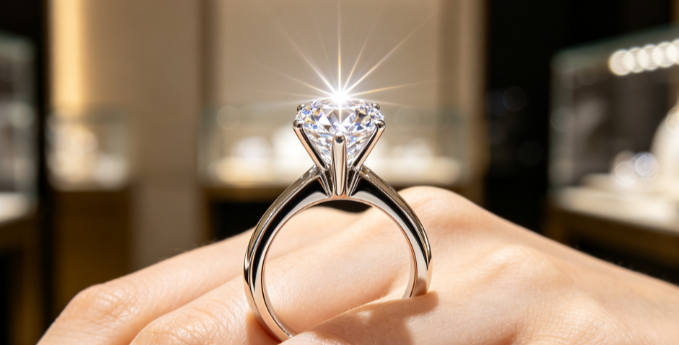
Because the shoulders flow into the head rather than stopping short of it, the ring reads as one sculpted piece rather than “a diamond stuck on a hoop.” This continuity is what gives cathedral rings their dressy, architectural character — visible in the polished white gold profile pictured above.
Gentle side protection
The rising shoulders stand slightly proud of the diamond’s girdle on the north and south sides, shielding those edges from glancing knocks. It is not full-body armor like a bezel setting, but it adds a layer of defense a flat band cannot offer.
Flatters the hand
A vertically elevated stone draws the eye along the finger, which many wearers feel lengthens and slims its appearance. Combined with a slim shank, the effect is graceful without being flashy.
Cathedral Setting vs Flat Solitaire Shank
| Aspect | Cathedral | Flat shank solitaire |
|---|---|---|
| Stone height | Elevated, high profile | Lower, closer to the finger |
| Light under the stone | More side light through the arches | Limited to what prongs allow |
| Visual effect | Prominent, formal, elongating | Understated, minimalist |
| Snag risk | Slightly higher (raised profile) | Minimal |
| Resizing | Needs a skilled bench near the arches | Straightforward |
Neither is better — they serve different tastes. The cathedral is for buyers who want ceremony in the silhouette; the flat shank is for those who want the diamond to float quietly. If ultimate low-profile comfort is your priority, compare the flush setting for lab-grown diamonds, which sets the stone down into the band entirely.
Honest Trade-Offs
- Height catches on things. The elevated head can brush against car door frames, gloves, and sweater knits more than a low-set ring would. Most wearers adapt within days.
- Cleaning matters more. Light entering through the arches means the underside of the stone is on display; an occasional soft brush under the girdle keeps it bright.
- Resizing needs care. Sizing a cathedral up or down requires reworking the curved shoulders, not just cutting a plain section of shank — a job for an experienced bench, not a mall kiosk.
- Not ideal for very active hands. If you work daily with tools or lift heavily, our guide to which diamond setting is most durable suggests lower-profile alternatives.
Popular Variations
- Full cathedral — deep arches with visible open space beneath the stone, maximum elevation
- Semi-cathedral — a gentler rise with partially filled undersides, like the subtle profile in the image above; the most popular modern interpretation
- Pavé cathedral — the arched shoulders carry a line of melee, combining elevation with a ribbon of sparkle
- Cathedral plus halo — an arched shank lifting a haloed head; the two effects multiply, though the ring grows taller still
Whichever variation you choose, the shape of your center stone should drive the head design — round brilliants suit classic four- or six-prong heads, while pointed shapes need tip protection as described in our V-prong guide for marquise and pear diamonds. For a shape-by-shape breakdown, see our guide to diamond setting types and which suits each cut, and for context across every major style, our roundup of the best settings for lab-grown diamond engagement rings compares them side by side.
Choosing the Metal
White metals emphasize the architectural lines of a cathedral — the arches read as clean sculpture, exactly as in this white gold example. Our comparisons of 18K vs 14K vs 9K gold and platinum vs 18K white gold cover hardness, color stability, and long-term value; platinum is especially fitting for tall profiles because it resists bending over decades of wear.
Sourcing a Well-Made Cathedral
Symmetric shoulders are a manufacturing challenge, which is why many jewelers buy diamond ring settings only from a factory — CNC-formed shanks hold the arch curves identical left-to-right, and our article on how a factory catches setting defects before shipping details the checks that keep the head level and the prongs true. Because the style is prong-based, plan on periodic inspections over the years; our piece on prong wear and restoring prong thickness explains the warning signs.
Conclusion
So, what is a cathedral setting? It is the design that turns the band itself into architecture: shoulders that arch upward, a head lifted into the light, and a diamond presented like the keystone of the whole piece. For a lab-grown diamond, it delivers drama, elegance, and a surprising amount of practical protection in exchange for a little extra height and occasional care around resizing and snagging. If you want your stone to sit on a stage rather than blend in, few designs do it better — and sourcing from an experienced lab-grown diamond manufacturer ensures both arches meet in perfect symmetry at the top.