Yes — a halo setting genuinely makes the center stone of a lab grown diamond ring look bigger, and the effect is one of the main reasons the style has become so popular. A halo is a circle of small diamonds set around the center stone, and because those melee stones reflect light right up to the edge of the center diamond, the whole cluster reads to the eye as one larger stone. How much bigger depends on the halo design, the shape of the center cut, and the width of the band — this guide breaks down exactly how the illusion works, how large the boost feels in practice, and when a halo is a smarter buy than simply upsizing the center diamond.
What Is a Halo Setting?
A halo setting surrounds the center diamond with a frame of small diamonds — usually tiny round brilliants called melee — set into the metal just around the girdle of the main stone. The frame can follow any outline: a circle for round and cushion centers, a cushion-shaped contour around an oval or emerald cut, or a custom trace around pear and marquise shapes. Beyond the classic single halo there are also double halos, hidden halos tucked beneath the center stone’s crown, and halos combined with pavé bands.
For a fuller tour of the style itself — history, variations, and construction — see our complete guide to the halo setting for lab-grown diamond rings. This article focuses specifically on the question buyers ask most: does the halo actually make your diamond look bigger?
The Short Answer: Yes, Noticeably
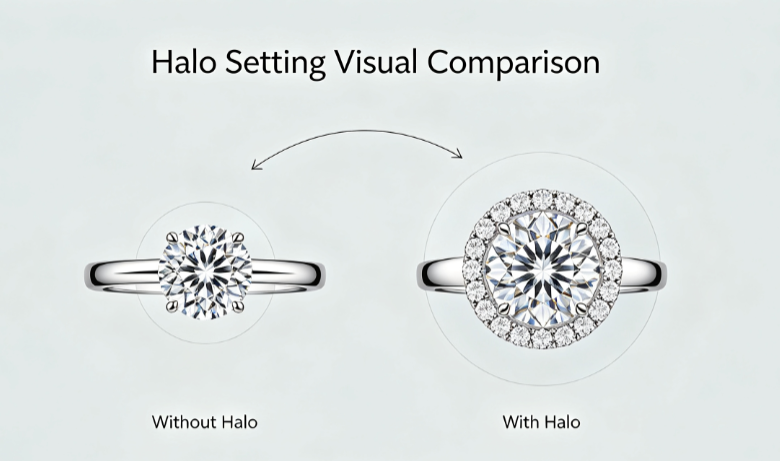
Put two identical center stones side by side — one solitaire, one haloed — and the halo version will look larger every time, even though both diamonds weigh exactly the same. The comparison image above shows precisely this effect on the same ring design: the haloed version has a visibly wider footprint across the finger.
As a rule of thumb used across the jewelry trade:
- A single halo adds roughly the visual presence of a quarter to half a carat, depending on the size of the melee
- A double halo can push the perceived size up by close to a full carat weight equivalent
- On smaller center stones (0.5–1.0 ct), the relative boost is dramatic; on stones above 2.5 ct the proportion change is subtler
Why the Illusion Works
1. Extended light return
A diamond sparkles by returning light to your eye. When a ring of small diamonds encircles the center stone, that entire zone flashes and glitters together. Your eye does not parse “center stone plus frame” at a glance — it registers one large, brilliant surface. More sparkling area equals more perceived size.
2. Contrast against skin
A bare solitaire shows finger skin directly beside the stone’s edge, which visually shrinks it. A halo replaces that skin contrast with bright white sparkle, so the “diamond area” extends all the way to the outer rim of the halo.
3. No reference scale
Because the melee stones blend into the center stone’s brilliance, the viewer loses the reference points needed to judge where the real stone ends. From conversational distance — the distance people actually admire rings — a well-made halo and its center read as one stone.
4. Band proportion
A halo widens the top of the ring relative to the band. The slimmer the band, the larger the haloed head looks by comparison — one reason halo designs pair so naturally with thin 1.6–1.8 mm shanks, often finished with pavé for an uninterrupted line of sparkle.
Which Shapes Benefit Most?
Round brilliants gain the classic full-circle halo shown in the image above. But shaped centers arguably benefit even more:
- Cushion cuts are the traditional halo partner — the soft square halo amplifies their pillow silhouette
- Oval and pear cuts gain length and presence from a following halo; for pointed tips, protection matters too, as covered in our guide to the V-prong setting for marquise and pear lab-grown diamonds
- Emerald cuts pair beautifully with a matching geometric halo that offsets their step-cut calm with a border of sparkle
Our guide to diamond setting types and which suits each cut maps every major shape to its most flattering options.
Honest Caveats: Where the Effect Ends
A fair answer to “does a halo make the center stone look bigger” includes the limits of the illusion:
- Up close, the halo is visible as separate stones. At arm’s length or closer, a careful observer sees the frame. Most wearers consider this a feature — extra sparkle — rather than a drawback.
- Carat weight does not change. The center stone itself is unchanged; if someone appraises or asks, the true carat number is what it always was.
- Small stones need occasional care. Melee in a halo sits in tiny prongs or beads. Our article on which diamond setting is most durable ranks halo work among the styles needing periodic inspection, and our piece on prong wear and restoring prong thickness explains what to watch over the years.
- More metal and labor. Setting dozens of melee accurately takes skill; a cheap halo with uneven beads is easy to spot.
Halo vs Buying a Bigger Stone
Here is where the economics get interesting, especially with lab-grown diamonds. Diamond price rises steeply with carat weight — a 2.0 ct stone costs far more than twice a 1.0 ct of similar quality. Adding a halo costs a fraction of that jump while delivering much of the same visual impact. If maximum presence per dollar is the goal, a 1.0–1.5 ct center in a generous single halo usually beats a plain 2.0 ct solitaire on both budget and everyday wearability. And since lab-grown pricing already stretches the budget further, many buyers combine the two advantages: a larger center and a halo, at a total still below the mined equivalent. Our roundup of the best settings for lab-grown diamond engagement rings compares the halo against solitaires, bezels, and three-stone designs; the three-stone setting is the other classic way to multiply visual size with side stones.
Choosing the Metal
White metals make a halo look seamless — the melee and the rhodium-toned setting merge into one bright field, maximizing the illusion. Our comparisons of 18K vs 14K vs 9K gold and platinum vs 18K white gold cover the durability and color considerations. Yellow gold works too, creating deliberate contrast that frames the halo instead of hiding its edge.
Quality Matters More in Halos Than Anywhere Else
The bigger-look effect depends entirely on craftsmanship. Evenly sized melee, consistent bead work, and a collar aligned to the center stone are what make the cluster read as one large diamond — sloppy work breaks the illusion instantly. That is why many jewelers source diamond ring settings only from a factory, where halo bead work is done by specialists; our step-by-step guide to the diamond setting process shows how much controlled work sits inside a good halo, and our article on how a factory catches setting defects before shipping lists the checks that keep melee tight and even. Buyers comparing protection-first alternatives should also read our new guide asking what is a bezel setting for lab-grown diamonds — some modern designs even combine a bezel center with a halo frame.
Conclusion
So, does a halo make the center stone of a lab grown diamond ring look bigger? Yes — reliably, visibly, and by roughly a quarter to half a carat of perceived size in a single-halo design. The mechanism is simple optics: more sparkling area, no skin contrast at the stone’s edge, and no reference scale to betray the boundary between center and frame. Accept that the melee needs occasional check-ups, choose a white metal to maximize the seamless effect, and above all insist on precise factory-grade setting work. Done well, a halo is the most cost-effective way to put a bigger-looking diamond on the hand — and working with an experienced lab-grown diamond manufacturer ensures every one of those tiny stones is set to hold its sparkle for decades.