Los tipos de engaste de diamantes que elija deciden mucho más que el aspecto de un anillo. El engaste adecuado protege la piedra, lo muestra en su forma más brillante, y resiste años de uso diario; el incorrecto puede dejar un hermoso diamante expuesto, inestable, o simplemente escondido. La clave es hacer coincidir los tipos de engaste de diamantes con el corte de la piedra: un brillante redondo y uno con forma de pera tienen necesidades muy diferentes.. Esta guía recorre los principales tipos de engaste de diamantes y explica qué corte se adapta mejor a cada uno..
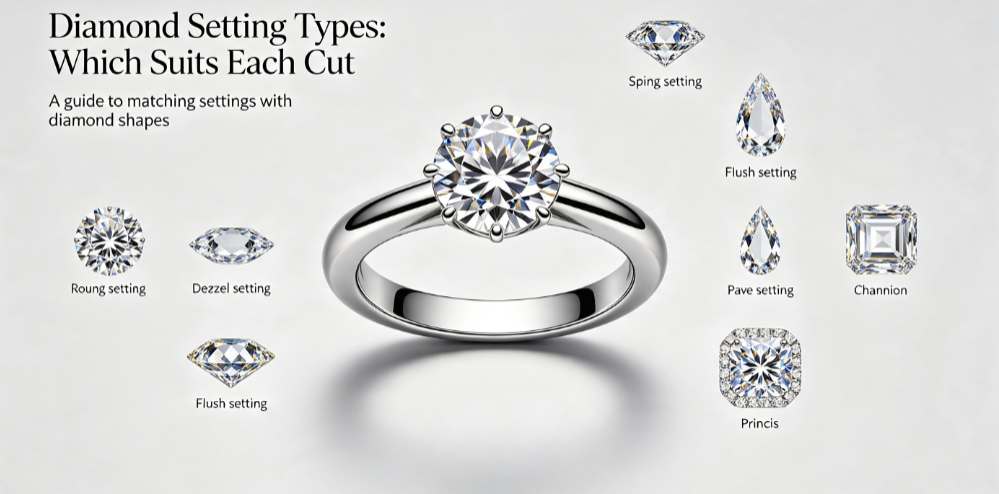
Los principales tipos de engaste de diamantes
Antes de hacer cortes coincidentes, ayuda conocer a los jugadores. Estos son los tipos de engastes de diamantes más comunes que encontrará al comprar un anillo:
Ajuste de puntas. El diamante está sujeto por una serie de garras de metal., normalmente cuatro o seis, que agarran la piedra por su cintura. Es el estilo más popular porque deja que la máxima luz llegue al diamante..
Ajuste del bisel. Un borde de metal envuelve completamente el borde de la piedra.. Ofrece una excelente protección y un elegante, aspecto moderno.
Ajuste de descarga. El diamante se coloca en un agujero perforado para que su mesa quede nivelada con la superficie metálica.. Popular para bandas y diseños de bajo perfil..
Configuración de canal. Los diamantes están alineados en fila entre dos paredes metálicas., sin puntas entre las piedras. Un favorito para la eternidad y las alianzas de boda..
Configuración del pad. Pequeños diamantes están engastados muy juntos con pequeñas cuentas de metal., creando una superficie brillante continua.
Ajuste de tensión. El diamante es atrapado por la presión similar a un resorte de la propia banda., sin puntas ni bisel visibles.
Cada uno de estos tipos de engaste de diamantes tiene sus propios puntos fuertes., y cada uno combina mejor con ciertos cortes que con otros.
Ronda brillante: El corte más flexible
El brillante redondo es la talla de diamante más popular del mundo, y también es el más indulgente cuando se trata de tipos de engaste de diamantes.. Su contorno simétrico y su fuerte forma sin esquinas hacen que casi cualquier entorno funcione bien..
A solitario de seis puntas es la elección clásica, ofreciendo elegancia y seguridad: las puntas adicionales protegen la faja redonda de golpes. A cuatro puntas La versión es más minimalista y muestra más piedra., a costa de una protección ligeramente menor. Para compradores que quieren máxima seguridad, a bisel alrededor de un brillante redondo le da un aspecto moderno con una protección excepcional.
Porque el corte redondo es muy versátil, La decisión generalmente se reduce más al estilo que a la necesidad, razón por la cual sigue siendo la primera opción más segura para los anillos de compromiso..
corte princesa: La protección lo es todo
La talla princesa es un brillante cuadrado o rectangular con cuatro esquinas afiladas - y esos rincones son su mayor vulnerabilidad. Un ajuste de puntas estándar deja las esquinas expuestas, y un solo golpe puede romperlos.
Para piedras talla princesa, Los mejores tipos de engaste de diamantes son aquellos que protegen las esquinas.:
- A Ajuste de punta en V, donde las puntas en cada esquina tienen forma de V para envolver las puntas afiladas
- A ajuste del bisel, que cubre todo el borde, incluidas las esquinas
- A configuración de canal para princesa piedras en fila
La regla general es simple.: si el ajuste no protege las esquinas, es la elección equivocada para un corte princesa. Este es uno de los ejemplos más claros de por qué es importante hacer coincidir los tipos de engaste de diamantes con la talla..
Cortes Esmeralda y Asscher: Muestra las facetas del paso
Los cortes esmeralda y asscher son formas escalonadas con largos, facetas abiertas y esquinas recortadas. Son apreciados por su elegante “salón de espejos” efecto, pero su mesa grande y su corona abierta significan que las inclusiones son fáciles de ver, y sus facetas escalonadas son menos indulgentes con las malas proporciones..
Para estos cortes, las mejores configuraciones son aquellas que Mantenga la piedra alta y sin obstáculos.:
- A ajuste de cuatro puntas con sustancial, puntas rectas en las esquinas
- A ajuste del bisel por una mas moderna, mirada protegida
- Configuración del canal cuando se utilizan varias piedras talladas en una línea
Las esquinas recortadas de los cortes esmeralda y asscher en realidad los hacen más fáciles de proteger que los cortes princesa: una punta de esquina bien colocada se asienta naturalmente en la esquina cortada.. Aún, Las facetas muy abiertas merecen un entorno que no las abarrote de metal..
Corte cojín: Un clásico que brilla en muchos entornos
El corte cojín es un cuadrado redondeado con esquinas suaves y grandes facetas que crean un ambiente cálido., brillo romántico. Combina maravillosamente con casi todos los estilos de configuración., lo que lo convierte en el favorito para diseños personalizados.
Los cojines lucen impresionantes en un configuración de halo, donde un anillo de diamantes más pequeños enmarca la piedra central y realza su tamaño percibido. También funcionan bien en configuración de puntas con puntas ligeramente más gruesas que hacen eco de las suaves curvas de la piedra, o en un bisel para una apariencia limpia y vintage-moderna.
Porque los cortes acolchados rara vez tienen puntas afiladas que proteger, la elección se reduce a la apariencia que desea: una decisión que se adapta bien a una conversación de configuración personalizada.
Cortes marquesa y pera: El desafío del extremo puntiagudo
Los cortes marquesa y pera tienen un punta puntiaguda Esa es la parte más frágil de cualquier diamante.. Ese consejo es donde ocurren las patatas fritas., y es exactamente donde muchas configuraciones estándar no ayudan.
La punta puntiaguda necesita protección dedicada, es por eso que un Engaste de punta en V para diamantes cultivados en laboratorio de talla marquesa y pera es la solución ideal: la punta en forma de V se envuelve alrededor de la punta en lugar de dejarla expuesta. Un ajuste de bisel es la otra opción segura, cubriendo completamente la punta.
Este es uno de los argumentos más sólidos para comprender los tipos de engaste de diamantes antes de comprar.: la misma hermosa piedra puede estar bien protegida o a un golpe de sufrir daños, dependiendo enteramente de la configuración.
Cortes Ovalados y Radiantes: Equilibrado y perdonador
Los cortes ovalados y radiantes se sitúan entre los extremos.. Los óvalos no tienen esquinas afiladas., por lo que toleran la mayoría de los entornos, aunque un seis puntas o un diseño de puntas ligeramente reforzado es aconsejable para piedras más grandes. Radiantes, como cortes de princesa, tener esquinas que merecen puntas en V o un bisel para una protección total.
Durabilidad: ¿Qué tipos de engaste de diamantes duran más??
Más allá de los cortes coincidentes, La durabilidad es el otro factor importante a la hora de elegir los tipos de engaste de diamantes.. Si quieres saber qué estilos aguantan mejor el uso diario real, nuestra guía para ¿Qué engaste de diamantes es más duradero? clasifica las opciones comunes según qué tan bien protegen una piedra a lo largo del tiempo.
La versión corta: ajustes de bisel y descarga Ofrecen la mejor protección porque cubren los bordes de la piedra.; configuración de puntas mostrar más del diamante pero exponer la faja; y configuración del pad agregue brillo pero traiga piedras pequeñas que necesitan una inspección regular. El equilibrio entre mostrar la piedra y protegerla está en el centro de cada decisión de ambientación..
Comparación de protección: Enrasado vs bisel
Dos de los tipos de engaste de diamantes más orientados a la protección son el enrasado y el bisel., y los compradores a menudo preguntan cómo se comparan. Ambos mantienen la piedra baja y segura., pero difieren en apariencia, rendimiento ligero, y como se sienten en el dedo. Nuestra comparación detallada de ajuste al ras versus ajuste del bisel desglosa exactamente qué formas de piedra favorece cada una y dónde se queda corta.
Hacer coincidir el ajuste con el metal
Los tipos de engaste de diamantes son solo la mitad de la ecuación: el metal del que están hechos es igualmente importante. Las puntas delgadas necesitan un metal fuerte; El trabajo pesado en pavé necesita una aleación que pueda contener piedras pequeñas sin desgaste.. Si estás decidiendo entre aleaciones de oro, nuestra comparación de 18Oro K versus oro de 14K versus oro de 9K para engastes de diamantes cultivados en laboratorio Cubre las diferencias prácticas en dureza y durabilidad..
Configuración de pedidos para sus propios cortes
Una vez que sepa qué tipos de engaste de diamantes coinciden con los cortes que vende, el siguiente paso es conseguir las monturas. Muchos joyeros y diseñadores compran ajustes de anillo de diamantes solo de fábrica — soportes confeccionados en el estilo adecuado, sin piedra, y luego engastan sus propios diamantes. Comprar soportes de esta manera le brinda acceso a precios de fábrica y a una calidad constante en todos los estilos..
También ayuda a comprender cómo se fabrica realmente una montura., desde el modelado CAD hasta la fundición y la inspección final. Nuestra guía paso a paso para el proceso de engaste de diamantes recorre todo el viaje, y nuestra mirada Cómo detecta una fábrica los defectos de configuración antes del envío explica los controles de calidad que separan las buenas monturas de las malas.
Mantener su entorno en buena forma
Por muy cuidadosamente que elijas los tipos de engaste de diamantes para tu anillo, ningún ajuste está libre de mantenimiento. Las puntas se desgastan con los años de uso., Y una punta desgastada es una piedra suelta esperando a suceder. Si nota que una punta parece más delgada que antes, nuestra guía sobre desgaste de las puntas y cuando es necesario restaurar el espesor de las puntas de un engaste de diamantes Explica las señales de advertencia y cómo se realizan los trabajos de reparación..
Conclusión
Los mejores tipos de engaste de diamantes son los que coinciden con el corte, protegiendo sus puntos más débiles., mostrando sus mejores facetas, y adaptarse a la forma en que realmente se usará. Los brillantes redondos son los más flexibles., Los cortes princesa exigen protección en las esquinas., Las piedras de marquesa y pera necesitan puntas en V o un bisel., y los cortes escalonados merecen una limpieza, entornos sin obstáculos.
Ya sea que esté eligiendo un engaste para su propio anillo de compromiso o buscando monturas para una colección, el principio es el mismo: entender el corte primero, luego elija la configuración que le sirva. Y cuando esté listo para obtener, un experimentado fabricante de diamantes cultivados en laboratorio puede ayudarle a combinar los tipos de engaste de diamantes correctos con las piedras adecuadas desde el principio.